
The Big Three
No, not the car makers

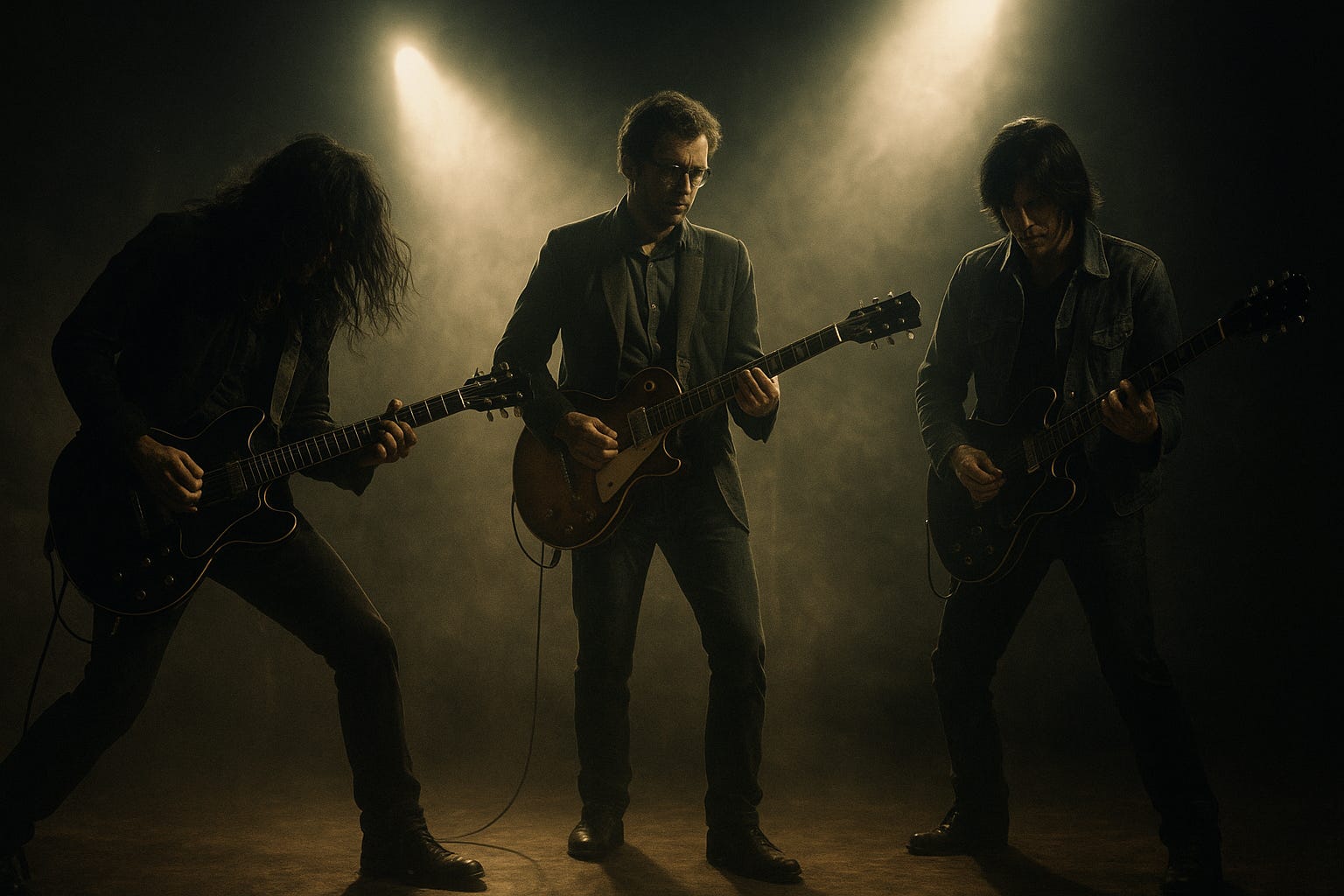
In the sixties, there were three principle classes of guitarists. Session players, who played on most of the hit songs of that era (without any credit), Band members who had to replicate what the session players played on the records they are billed on and get credit for, and then the guitar gods, who played and composed their own songs.
Several session guitarists rose out of the session scene to forge their own path. A famous example is Glen Campbell, who who was a gifted session player who was able to break out and record his own albums that became such big hits he got his own TV show.
But, over in jolly ol’ England three guitarists were regarded as the best of the best. Eric Clapton, Jimmy Page, and Jeff Beck.
I never really got Eric Clapton’s solo work. I loved his music when he was with Derek and the Dominos and Cream, but his later stuff (Slowhand, etc.) was bleh, even though songs from that album were probably ones he was best known for.
But the song I most love is Layla, a song that is to me one of the great rock songs of the decade. But the funny thing is, outside of the opening guitar riff and melody, the song is best when it shifts into the second part where it’s piano and slide guitar, and the slide guitar isn’t Clapton, but Duane Allman of the Allman Brothers. Although the supergroup Cream with Ginger Baker, Jack Bruce and Clapton had a lot of great songs, Layla from his time in Derek and the Dominos was his best.
But I never really felt he deserved the “Clapton is God” label. He’s good, but not epic.
Jimmy Page is also a session player that at a young age started playing in bands like the Yardbirds and gained a reputation as a great guitarist. When he formed his own super group with Robert Plant, John Paul Jones and John Bonham, he exploded in popularity and started to get held up to the same standards as Clapton.
Now, what Jimmy Page was great at, his true gift, is stealing other peoples work and making a Led Zeppelin version. Well, I joke, kind of. But a lot of their early music was “inspired” by blues recordings from several other earlier works by Willie Dixon and Sonny Boy Williamson among others who eventually had to sue and get writing credits.
Outside of that, Jimmy was a master of song writing, especially songs using alternative tunings for his guitars to come up with completely new melodies and chords. His best example is “The Rain Song” off of their Houses of the Holy album (one of their best albums, next to their 4th). His clever alternative tuning of DGCGCD created some really beautiful sounds. I think their best version is their live one from the Album “The Song Remains the Same”
The only reason why this song exists is because George Harrison (of the Beatles) made the comment that Led Zeppelin never wrote any ballads. The Rain Song was Jimmy’s answer to that.
But otherwise, I called Jimmy Page the slopmeister. Master of the sloppy guitar solos. Especially if you listen to other live recordings, his guitar playing, especially his solos, were such messes. But I do have to give him epic status for his stunning catalog of music.
Last but not least, Jeff Beck.
I wasn’t a big fan of Jeff Beck, and he certainly never rose to the prominence of his other contemporaries like Clapton and Page, but he did have a devoted following.
He mainly played in short lived bands, and did occasional session work, before following Clapton as guitarist for the Yardbirds. He also had formed several different groups featuring other big name artists like John Paul Jones, Keith Moon, Rod Stewart, Carmine Appice among others. At one point he was even considered replacing Syd Barrett when Syd left Pink Floyd, but according to Nick Mason, they were “too scared to ask him”. I can’t imagine what Pink Floyd would have turned into if that had happened, as it was a miracle that they brought in David Gilmour instead and the rest is history.
He did eventually strike out on his own with his 1975 debut solo work “Blow by Blow”, which I did buy when I was a teenager but rarely listened to.
I just never understood the accolades he received. He may be a great guitarist, but he never really had any break out hits to his writing credit that I am aware of. Even Rolling Stone magazine continues to list him at one of the top five all time greatest guitarists. I think he’s more given credit for innovations rather than technical skill.
I just think that while you can point to these three men as pioneers and innovators of rock music in the 60s, men who later influenced so many more modern guitarists, their abilities as musicians have been overshadowed by those that came later. Even other guitarists from that era were more talented, such as Jimi Hendrix and Terry Kath (Chicago) were arguably better guitarists, but they were cut down too young, Jimi by overdose, Terry by an accidental gun discharge.
I’m A Man - Terry Kath on guitar
Hell, he’s not even mentioned in Rolling Stone’s top 100 guitarists. Truly underrated. And Jimi - who is #1 btw, claimed that Terry Kath was “the best guitarist in the universe”.
But I digress.
So, do you think these three get such high status as rock gods? Let me know why or why not in the comments.
Here’s a shot in the dark (or maybe dim light) on your answer of those three guitar legends.
As you mention, all three were at one time members of the Yardbirds. I think for one album both Beck and Page were in the group at the same time. But one other thing that they had in common was they were British, right int he middle of the famous “British Invasion.” You had the Beatles and the Stones, as well as the Dave Clark 5, the Kinks, the Who, and a slew of others. It totally changed the music scene, and you had these three guitarists who were members of a successful group that was part of that scene. But at the same time, all three weren’t really tied into a specific group like George Harrison and Keith Richards were (at least until Page got Led Zeppelin started.) I remember reading a book where Clapton never considered it a necessity to be a permanent part of any particular band, that he could go from band to band as they record albums – “I thought it was a natural thing to do.” As such, there’s a level of independence with these three that made them stand out.
In addition to the British Invasion, it was also the dawn of harder Rock with a strong guitar lead. Yes, we did have guitar leaders in the past such as Duane Eddy, but I’m thinking there’s a factor in there that I can’t really describe correctly.
You had to bring up Terry Kath. Having almost all of Chicago’s early albums (the only ones I don’t have with Kath on them are V and XI) I’m fully aware of what he could do. He was actually the leader of that group during his tenure, even though you were more likely to hear Robert Lamm on lead vocals, which slowly switched to more Peter Cetera by the mid 1970’s. Despite all that, he was the member who was most out front at the concerts. You provided the link to “I’m a man,” but you get a super-strong solo even with the first track on side 1, aptly titled “Introduction.” Ironically, I was playing that track the day before you published this article! In addition to the solos in their “Protest era” albums, he had a screamer in their 1975 album Chicago VIII, with “Oh, thank you great spirit.” 7 minutes. Starts out slow and easy, but ends (and I love that end!) with your speakers on fire. His death really changed the band. In a short few years and a couple of changes in producers, David Foster turned them into a soft pop group and deemphasized the horns, and the result was 4 of their best-selling albums. 100% different from the first 5 albums. Almost impossible to be a fan of both eras.
Guitarists now? Tons of talent out there, but you never hear them reach the status of the earlier ones. Probably because they were the pioneers of their era.